




PBSR – Abstracts
Abstracts from Papers of the BSR Vol. 77 (2009)
Integrating lidar and geophysical surveys at Falerii Novi and Falerii Veteres (Viterbo)
pp. 1–27 and 335–43 Rachel Opitz
The Roman town of Falerii Novi and the pre-Roman Falerii Veteres are revisited through a combination of lidar (airborne laser scanning) and geophysical survey data in this paper. The lidar survey provides detailed information on the topographically complex edges of these sites for the first time, and a number of new features are identified. Viewing these features in the context of both the topographic and geophysical data, these peripheral urban areas are explored, both as zones for movement and as façades. Through these examples, the potential contributions made by lidar to our overall understanding of pre-Roman and Roman urbanism are considered.
Lixus (Morocco): from a Mauretanian sanctuary to an Augustan palace
pp. 29–64 Carmen Aranegui and Ricardo Mar
This article reassesses the work of M. Ponsich, published in 1981, on the monumental centre of Lixus (Morocco). He interpreted the structures found in the excavations begun by Tarradell in 1948 as a set of linked sanctuaries, principally of the Roman period. This new examination of the preserved remains, together with more recent excavations, allows us to reassess this area of the site. It is possible to identify the remains of a large sanctuary of the Mauretanian period (fourth–first centuries bce), which includes temples, gardens and storehouses. In the period of Juba II (30–10 bce) a palace was constructed over the gardens, adjacent to the earlier temples. This residential complex had a Corinthian atrium and two peristyles. It has been possible to identify also the oecus triclinaris, cryptoporticus, exedrae and halls. We propose that this palace is one of the residences of Juba II.
Revisiting the pediment of the Palatine metroön: a Vergilian interpretation
pp. 65–99 Roslynne Bell
In this article the pediment of the Magna Mater’s Augustan temple on the Palatine is re-examined. Arguments in favour of reference to the sellisternium, and traditional identifications of the composition’s main figures as either Attis or galli, are considered. An alternative reading of the pediment is proposed. Using the pine branch as a key, Vergil’s Aeneid is put forward as an iconographic ‘blueprint’ for a scene in which the Magna Mater is celebrated as both a national goddess of Rome and the tutelary deity of Augustus and the Julio-Claudii. The figures in question are re-identified as personifications of the Trojan Mount Ida and the Palatine Hill — important loci of worship in the east and the west, and symbols of the dual heritage shared by the Magna Mater, Rome and the princeps himself.
A baker’s funerary relief from Rome
pp. 101–23 Andrew Wilson and Katia Schörle
This article presents a previously unpublished Roman travertine relief showing scenes of breadmaking, currently in the restaurant Romolo in Trastevere in Rome. It presumably came originally from a tomb monument, possibly in the vicinity, and might be dated on grounds of material and style anywhere between the very late Republic and the Flavian period. From left to right it shows two men delivering sacks of grain, a man loading grain into an animal-driven mill, three men kneading dough by hand, three more shaping loaves, and one putting loaves into the oven. The article discusses parallels in other reliefs of bakery scenes, and highlights the importance of this one for the evidence that it provides for the extent of the division of labour in a fairly large-scale bakery, in which the breadmaking process is divided into stages, each carried out by different groups of people.
Trajanic building projects on base-metal denominations and audience targeting
pp. 125–58 Annalisa Marzano
Imperial coinage is generally recognized as one of the media used by the central administration to spread specific ideological messages, even though the extent to which specific messages could be understood across the wide spectrum of Roman society remains open to debate. Even more problematic is the question of whether specific coin types were chosen according to the different denominations (precious versus base metal), thus taking into account the social and geographical background of the potential coin-users. This study investigates the possibility of audience targeting in Trajanic coins with architectural types of the mint of Rome and then compares these issues with similar coins minted under the Flavians and Hadrian. The analysis highlights how building projects that had primary relevance for Rome’s populace, such as the restoration of the Circus Maximus, were commemorated on base metal alone, whereas projects that had a wider resonance across the empire, as in the case of the Forum of Trajan, were depicted on precious and base metal, thus showing that in specific cases a clear pattern of audience targeting can be detected.
Excavations at Le Mura di Santo Stefano, Anguillara Sabazia
pp. 159–223 Robert Van de Noort and David Whitehouse
This report presents the results of excavations undertaken between 1977 and 1981 at the remarkable ruins known as Le Mura di Santo Stefano, situated near Anguillara Sabazia, just under 3 km south of Lake Bracciano. The earliest phase of occupation concerned a first-century ad farm. Around ad 200 a range of buildings was constructed, including a three-storey rectangular building lavishly decorated with nineteen types of marble, suggesting that the complex was a luxury retreat, possibly part of a latifundium. There is evidence for further activity in the third or early fourth century. In the ninth century, after a period of abandonment, part of the complex was converted into the church of Santo Stefano. The rectangular building was reoccupied and the remaining ruins used as a cemetery. It is argued that the site may have functioned as the centre of a medieval estate, part of a papal domusculta, or alternatively as a fundus of a monastic establishment. In the eleventh century the site was deserted after the skeletal remains of a least 90 individuals, along with the bones of three dogs, were interred in a pit and capped with several pieces of Roman marble sculpture.
Medieval wall painting in the church of Santa Maria in Pallara, Rome: the use of objective dating criteria
pp. 225–55 and 344 Laura Marchiori
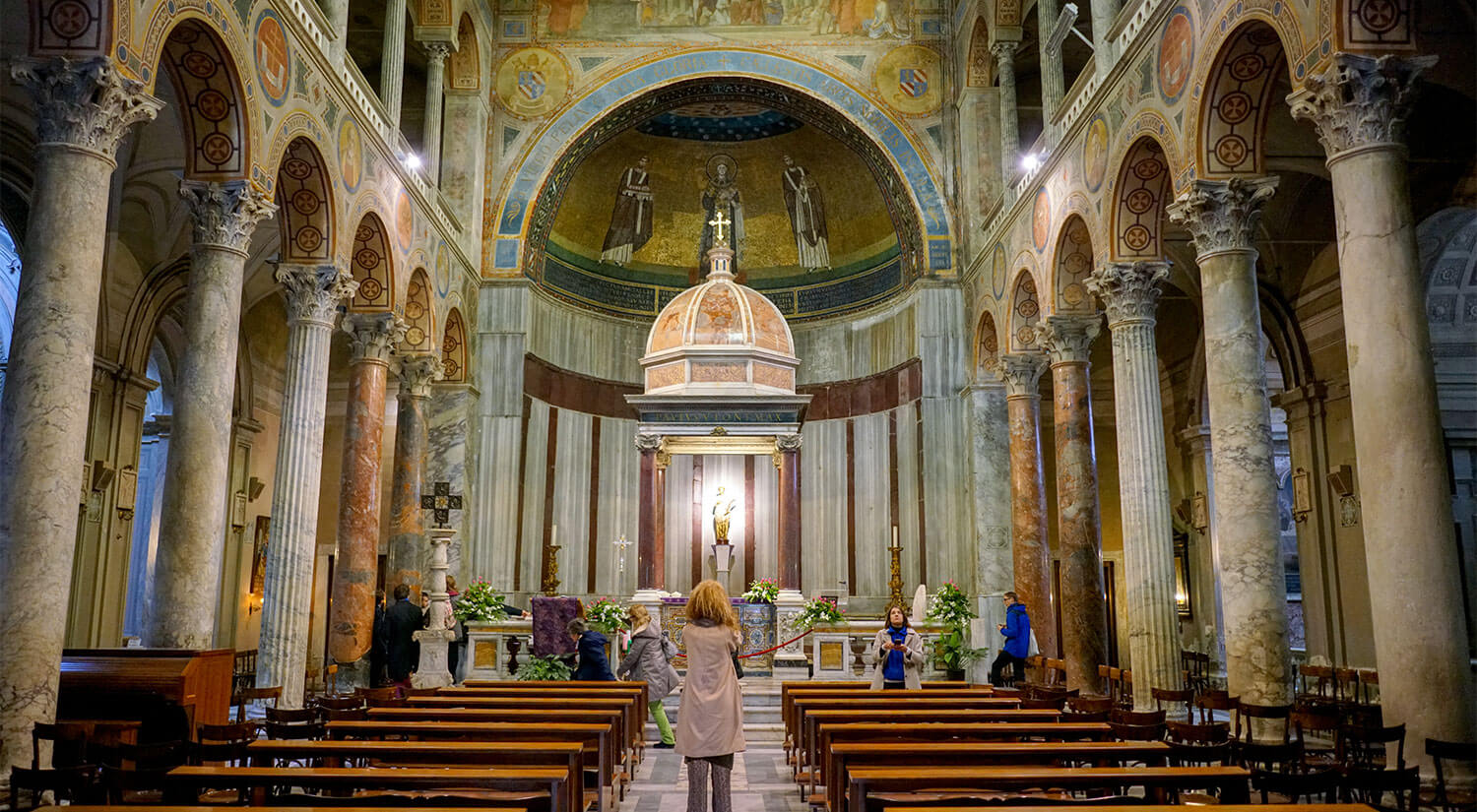
The medieval wall paintings in Santa Maria in Pallara have received little scholarly attention, perhaps on account of uncertainty about their dating; there is no independent textual documentation for their production. Traditionally dated to the tenth century, the paintings exhibit an iconography more common to twelfth- and thirteenth-century contexts, a representation of the Apostles seated on the shoulders of Prophets, which no doubt contributes to their neglect, since the later monuments are so well documented. However, the iconography derives from Roman traditions of church decoration, traditions that may be utilized in an analysis of the paintings in order to arrive at an independent dating based on their form and content alone. Following a methodology developed by John Osborne for dating undocumented medieval wall paintings in Rome, this article analyzes the objective dating criteria of the Santa Maria in Pallara paintings; namely, these criteria are physical setting, function, subject matter, inscriptions and pictorial technique. Such analyses suggest that a tenth-century date is suitable for the paintings, which are well categorized in the history of Roman pictorial technique between securely dated ninth-century monuments and those dated to the eleventh and twelfth centuries.
Governor and government in sixteenth-century Rome
pp. 257–72 Miles Pattenden
The quantity of government in Rome and the role of the pope and his officials in it increased rapidly during the sixteenth century. This article takes the figure of the city’s Governor as a case study and, using legislative, archival and financial records, asks how we can measure that process and what it reveals about the aspirations of Romans for government. It concludes that this expansion was not the result of deliberate centralization or rationalization by sixteenth-century popes, but that different groups within Roman society exploited the idea of papal authority to advance their own interests and encourage political stability. Finally, it considers the consequences this had for the development of Rome as a polity and argues that in the centuries before the French revolution, far from being a cause of stagnation and decline, papal government continued to evolve to meet the expectations made of it by the ancien régime society.
The Villa Pigneto Sacchetti excavation: a new interpretation
pp. 273–90 Phil Perkins and Sally Schafer
The remains of the seventeenth-century Villa Pigneto Sacchetti lie in Rome to the northwest of the Vatican City, on a steep slope in the Valle dell’Inferno in the regional park of Monte Mario. Designed for the Sacchetti family by Pietro da Cortona, it was one of a limited number of his architectural projects to be built. In 1990 the villa was believed lost, and so a project was devised to locate and explore the material remains; and in 1992 we partially excavated the villa and subsequently published an excavation report (published in Papers of the British School at Rome 68 (2000)). In 2008, Jörg Martin Merz’s much-awaited monograph, Pietro da Cortona and Roman Baroque Architecture, was published. Without any doubt, this book makes a major contribution to the architectural literature of the Roman Baroque. It includes a chapter on the Villa Pigneto Sacchetti, which takes issue with some of our findings. This article addresses several points raised about our work, and offers a reinterpretation of the building history of the villa that aims to reconcile the divergent opinions and incorporate advances in scholarship since 2000.
Notes from Rome
pp. 291–7 Robert Coates-Stephens
This gazette aims to present to a readership outside Rome a newsletter of recent archaeological activity (chiefly for 2008, although also early 2009) gleaned from public lectures, conferences, exhibitions and newspaper reports.
var _gaq = _gaq || [];
_gaq.push(['_setAccount', 'UA-23718173-1']);
_gaq.push(['_trackPageview']);
(function() {
var ga = document.createElement('script'); ga.type = 'text/javascript'; ga.async = true;
ga.src = ('https:' == document.location.protocol ? 'https://ssl' : 'http://www') + '.google-analytics.com/ga.js';
var s = document.getElementsByTagName('script')[0]; s.parentNode.insertBefore(ga, s);
})();
Latest edition
Thursday 1 September 2011
The Papers – Vol 78 (2010)
xiv, 354 pages, including 101 black and white illustrations and 8 colour plates
Christopher Smith and John Richardson, Geoffrey Edwin Rickman (1932–2010)
Papers
Sophie Hay, Paul Johnson, Simon Keay and Martin Millett, Falerii Novi: further survey of the northern extramural area
Marden Nichols, Contemporary perspectives on luxury building in second-century BC Rome
Maureen Carroll, Exploring the sanctuary of Venus and its sacred grove: politics, cult and identity in Romen Pompeii
Filippo Coarelli, Substructio et tabularium
Dirk Booms, The vernae Caprenses: traces of Capri’s Imperial history after Tiberius
Elizabeth Fentress, Cooking pots and cooking practice: an African bain-marie?
Meaghan McEvoy, Rome and the transformation of the imperial office in the late fourth–mid-fifth centuries AD
Anne Alwis and Ellen Swift, The role of late antique art in early Christian worship: a reconsideration of the iconography of the ‘starry sky’ in the ‘Mausoleum’ of Galla Placidia
Gillian Mackie, Warmundus of Ivrea and episcopal attitudes to death, martyrdom and the millennium
Ian Campbell and Robert W. Gaston, Pirro Ligorio and two columna caelata drawings at Windsor Castle
Robert Coates-Stephens, Notes from Rome 2009–10
Research Reports
Balsdon Fellowship (Michael Bury)
Cary Fellowship (Robert Coates-Stephens)
Hugh Last Fellowship (Stephen Heyworth)
Paul Mellon Centre Rome Fellowship (William Eisler)
Rome Fellowships (Carrie Churnside, Emiliano Perra)
Rome Scholarships (Meaghan McEvoy, Lucy Turner Voakes)
Ralegh Radford Rome Scholarship (Marden Nichols)
Macquarie University Gale Scholarship (Duncan Keenan-Jones)
Rome Awards (Caillan Davenport, Claire Holleran, Elizabeth Munro, Edward Payne)
Tim Potter Memorial Award (Alun Williams)
Giles Worsley Travel Fellowship (Rebecca Madgin)
Archaeological Fieldwork Reports
Ed Bispham and Susan Kane
Domenico Camardo, Domenico Esposito, Catello Imperatore, Mario Notomista, Sarah Court and Andrew Wallace-Hadrill
Amanda Claridge and James Andrews
Filippo Coarelli, Stephen Kay and Helen Patterson
Elizabeth Fentress
Sophie Hay, Elizabeth Fentress, Nabil Kallala, Josephine Quinn and Andrew Wilson
Sophie Hay, Stephen Kay, Jessica Ogden and Gregory Tucker
Simon Keay
Myles McCallum and Hans vanderLeest
Roman Roth and Carrie Murray
Alastair Small